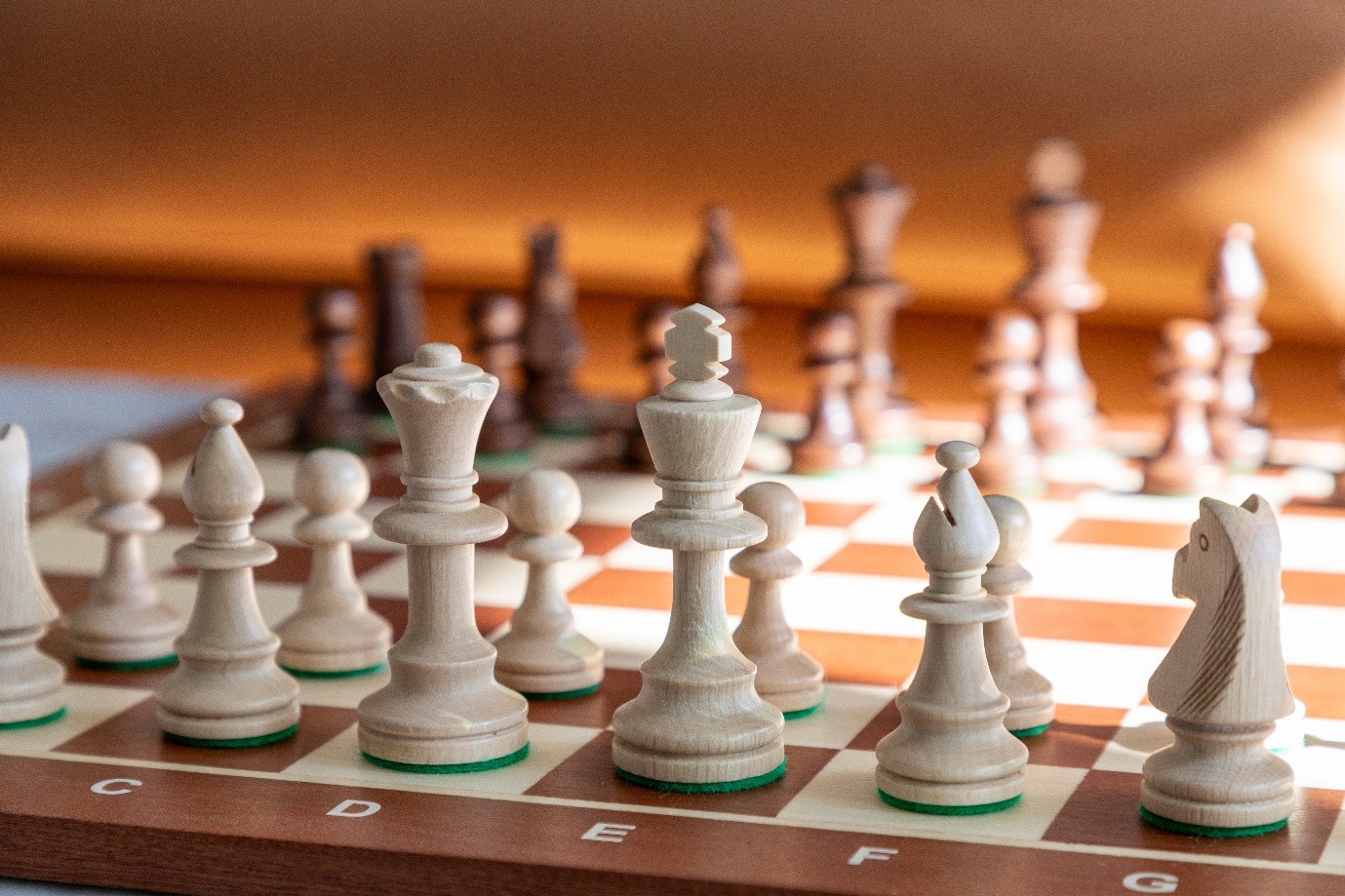

Chess starts with a board, but it’s much more than 64 squares. Understanding the chessboard and pieces is the foundation of every game, from casual Kick Off-style matches with friends to serious tournament play. I’ve been fascinated by this since my dad first taught me the game, and playing at the UK nationals when I was 10 gave me a firsthand view of how every square and piece matters.
Whether you’re a beginner or a casual online player, knowing the layout, piece movements, and strategic value is essential.
The Chessboard: Layout and Coordinates
The chessboard is an 8×8 grid, alternating light and dark squares. Each square has a unique coordinate, combining a letter (a-h) for the column and a number (1-8) for the row. This is called algebraic notation, and it’s the language of chess. Every move can be recorded using this system, whether in tournaments or online games on Chess.com.
- The bottom-right square is always a light square.
- White pieces start on ranks 1 and 2, black pieces on ranks 7 and 8.
Knowing the board isn’t just about memorization; it’s about spatial awareness. Chess isn’t just which piece to move — it’s about controlling space, timing attacks, and coordinating your forces across the board.
The Pieces and How They Move
Every chess game involves 16 pieces per side, each with unique abilities and strategic roles.
King

- Moves one square in any direction.
- Objective: keep the king safe while trying to checkmate the opponent.
- Special move: castling — moving the king two squares toward a rook and jumping the rook over.
The king is priceless. Losing it means losing the game, which is why it’s the focal point of every strategy.
Queen

- Moves any number of squares horizontally, vertically, or diagonally.
- Most powerful piece due to flexibility.
I’ve always loved the queen for her versatility. In my experimental style, I often use her to dominate open lines and create unpredictable threats — a bit of a Fischer-inspired approach, always thinking several moves ahead.
Rooks

- Move any number of squares horizontally or vertically.
- Strong in the endgame, especially when connected across the board.
Rooks shine in open positions and are often underestimated by beginners. Coordinating rooks with queens or bishops can overwhelm even highly rated opponents online.
Bishops

- Move diagonally across the board.
- Cover long ranges, often controlling entire diagonals.
Personally, I value bishops slightly higher than knights (I give them 3.5 points instead of 3) because their range allows for tactical domination. Early on, I liked placing bishops to create weird pinning combinations, something even modern streamers experiment with in blitz games.
Knights

- Move in an L-shape (two squares in one direction, one perpendicular).
- Can jump over other pieces, making them unpredictable.
Knights are tricky and excellent in closed positions. In my more experimental games, knights often created chaotic threats that caught opponents off-guard. Fischer, too, appreciated knights’ tactical value, especially in unusual openings.
Pawns

- Move forward one square, with the option to move two squares from their starting position.
- Capture diagonally, not straight.
- Can promote to any other piece (usually a queen) upon reaching the last rank.
Pawns control space and structure the game. Early pawn moves often dictate opening strategy, and mastering pawn structure is key to long-term success.
Understanding Piece Value
Every piece has a conventional point value:
- Pawn = 1
- Knight = 3
- Bishop = 3
- Rook = 5
- Queen = 9
These numbers help guide trades, but chess isn’t just arithmetic. Position, activity, and coordination often outweigh raw points. For example, two bishops can dominate the board even against a queen if they control complementary diagonals.
The Importance of Coordination
Pieces don’t act alone. Every move interacts with others:
- Rooks and queens dominate files and ranks.
- Bishops sweep diagonals and work well in open games.
- Knights jump into weak squares, creating forks and tactical threats.
During my experimental games as a child, I loved creating “weird” positions — leaving pieces in unusual places to test tactics. Even now, watching streamers like Hikaru Nakamura, xQc, and Ludwig do unorthodox plays online reminds me of that playful spirit.
Chess Notation: Recording Moves
Algebraic notation is the universal language. Each piece is represented by a letter (K = King, Q = Queen, R = Rook, B = Bishop, N = Knight; pawns have no letter). Moves are written as the piece + destination square:
- e4 = pawn moves to e4
- Nf3 = knight moves to f3
- O-O = kingside castling
Recording moves helps you review games, learn from mistakes, and share strategies, whether in-person or on Chess.com. Fischer famously studied thousands of games this way, and modern players still do the same.
Chess Online: The Modern Era
Chess has evolved from boards and tournaments to a global online phenomenon. Streaming platforms like Twitch have made chess exciting and accessible, with personalities like Hikaru Nakamura, xQc, Ludwig, and others entertaining millions. Chess.com is king in this space, providing tools for practice, puzzles, and live competitions.
For someone like me — who grew up playing physically at clubs and tournaments — it’s amazing to see the game thrive digitally. You can now experiment, analyze, and compete against players worldwide without leaving your house.
Why Pieces and the Board Matter
Understanding the chessboard and pieces is about more than memorizing moves. It’s about strategy, coordination, and spatial awareness. Each piece contributes uniquely to your plan, from pawns controlling space to bishops slicing diagonals to queens dominating multiple threats at once. Mastering these fundamentals allows you to enjoy chess at any level — whether casually online or in serious competitions.
Chess is a game of infinite possibilities, and learning the board and pieces is your first step into that universe. From Fischer’s brilliance to modern streaming chaos, every move counts — and every piece has a story.