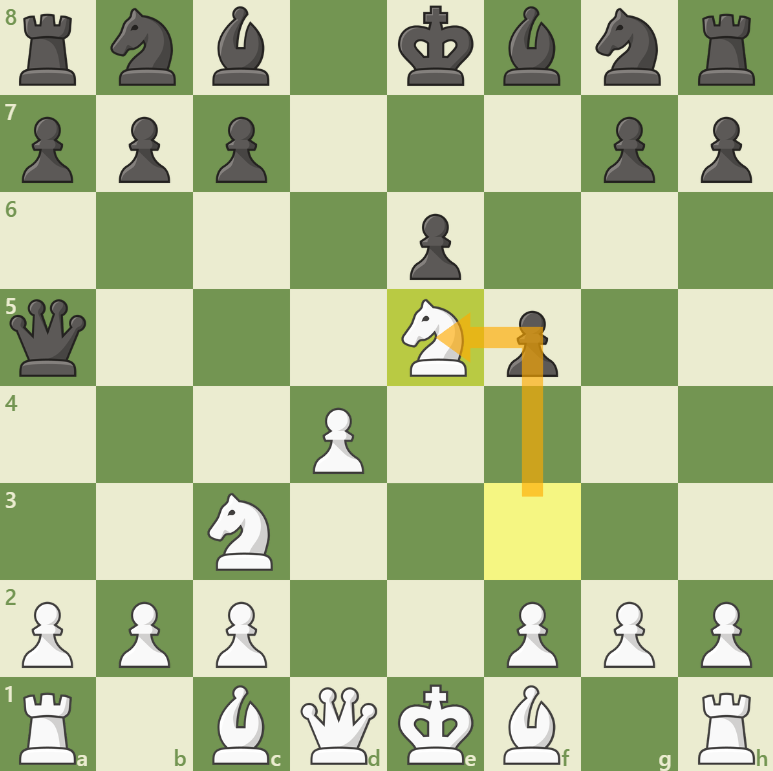

An outpost is a square that can’t be attacked by the opponent’s pawns, usually because the pawns that would normally guard it have been traded off or pushed too far forward. When a pawn of your own also protects that square, you get a protected outpost, which is the strongest version of the idea.
A knight is the ideal piece to occupy an outpost. As a short-range piece that jumps over other pieces, a knight on a safe square can sit there for the rest of the game, immune to direct challenge, while every other piece maneuvers around it. From a central outpost, a knight can also reach squares that bishops, rooks, and queens simply can’t, since it’s the only piece that controls both light and dark squares from a single, fixed point.
How to Create a Knight Outpost
To make an effective knight outpost, you can’t simply advance the knight. A proper strategy is required, for which you need to consider certain things, including:
Identity: The very first step in creating a knight outpost is recognizing weak squares in your opponent’s position that can no longer be controlled by their pawns. This is common after a pawn exchange or when the opponent advances their pawns too far.
Piece Placement: Develop a protected knight outpost by moving other pieces that support the knight and protect it. Isolated knight outposts won’t give you much advantage over a knight outpost sheltered by bishops, rooks, and pawns.
Routing: The movement of knights to build an outpost is as important as its positioning. Move the knight strategically to reach its ideal square by keeping it protected. You must protect the outpost with a pawn before moving the knight to that position.
Opponent’s pawn: Be careful of the opponent’s pawns, as they can take the knight most effectively. If there is a pawn that can attack your knight, exchange it or distract it with other movements before placing your knight.
Effective Use of a Knight Outpost
The main purpose of developing a knight outpost is to create pressure and strategize effectively rather than immediately attacking the opponent’s pieces. A centralized outposted knight can attack multiple pieces at once, forking knights, rooks, the king, and the queen. It also restricts the opponent’s positioning, improving pressure. Sometimes, a knight outpost square is considered more effective than a bishop.
Knight outpost helps attack the opponent’s king more easily by becoming a centerpiece of attack. It also targets the key defense and escape squares of the opponent, limiting the opponent’s mobility and providing you with a strategic advantage. Once a knight outpost is effectively created, you must not rush but use strategy and plan your attacks effectively. Don’t exchange your knight unless you see a clear advantage.
Conclusion
A knight outpost is not just a protected square. It’s a base made by strategy to attack an opponent’s pieces, restricts the enemy’s movement, creates tactical threats, and has control of the board. A good player not just creates a strategic outpost but also develops their whole midgame around it. It provides a significant positional advantage to the player. With regular practice and analysis of games, you can learn to recognize and build a knight outpost and use it effectively for your advantage.